<?xml version="1.0" encoding="UTF-8"?>
<!--Generated by Squarespace V5 Site Server v5.13.159 (http://www.squarespace.com) on Thu, 23 May 2013 08:08:00 GMT--><feed xmlns="http://www.w3.org/2005/Atom" xmlns:dc="http://purl.org/dc/elements/1.1/"><title>Simon Ward - Money Moves Markets</title><subtitle>Journal</subtitle><id>http://moneymovesmarkets.com/journal/</id><link rel="alternate" type="application/xhtml+xml" href="http://moneymovesmarkets.com/journal/"/><link rel="self" type="application/atom+xml" href="http://moneymovesmarkets.com/journal/atom.xml"/><updated>2013-05-21T16:57:07Z</updated><generator uri="http://five.squarespace.com/" version="Squarespace V5 Site Server v5.13.159 (http://www.squarespace.com)">Squarespace</generator><entry><title>UK temporary inflation fall boosts second-half economic prospects</title><id>http://moneymovesmarkets.com/journal/2013/5/21/uk-temporary-inflation-fall-boosts-second-half-economic-pros.html</id><link rel="alternate" type="text/html" href="http://moneymovesmarkets.com/journal/2013/5/21/uk-temporary-inflation-fall-boosts-second-half-economic-pros.html"/><author><name>Simon Ward</name></author><published>2013-05-21T10:21:03Z</published><updated>2013-05-21T10:21:03Z</updated><content type="html" xml:lang="en-GB"><![CDATA[<p>CPI inflation was expected to fall in April because of lower petrol prices and a favourable Budget base effect but the outturn of 2.4% was below a projection here of 2.6% (also the consensus forecast). The chart shows a revised profile incorporating the modest good news in today&rsquo;s release. Inflation is projected to rebound to a peak of 3.3% in June before falling back to average 2.8% during the second half of the year.<br /><br />Suggestions that today&rsquo;s news marks the start of a new favourable trend are unconvincing:</p>
<ul>
<li>
<p>Price expectations balances in business and consumer surveys are in the middle of their ranges in recent years, during which inflation has consistently overshot the 2% target.</p>
</li>
<li>
<p>Import prices have yet to respond fully to sterling weakness since late 2012.</p>
</li>
<li>
<p>Wholesale petrol prices are rising again. The drag effect on annual inflation will reverse even assuming stable pump prices.</p>
</li>
<li>
<p>A continued revival in economic momentum during 2013 may encourage more firms to raise prices, given modest spare capacity and below-average margins.</p>
</li>
<li>
<p>Stronger monetary growth since late 2011 should begin to exert upward pressure from late 2013, based on Friedman&rsquo;s average two-year lead from money to prices.</p>
</li>
</ul>
<p>The recent inflation fall, nevertheless, has improved economic prospects for the remainder of the year by giving a further boost to real money supply expansion.</p>
<p>The new CPIH inflation measure incorporating owner-occupiers&rsquo; housing costs fell to 2.2% in April. Such costs, however, are supposedly rising at an annual rate of only 1.0%. This is difficult to reconcile with other information: the CPI index of actual rents increased by an annual 2.6% in April, while the deflator for imputed rents in the national accounts climbed 5.7% in the year to the fourth quarter of 2012.<span class="full-image-block ssNonEditable"><span><img src="http://newstar.squarespace.com/storage/130521-chart1.gif?__SQUARESPACE_CACHEVERSION=1369133606676" alt="" /></span></span></p>]]></content></entry><entry><title>Why UK 2013 growth of 2% remains achievable</title><id>http://moneymovesmarkets.com/journal/2013/5/20/why-uk-2013-growth-of-2-remains-achievable.html</id><link rel="alternate" type="text/html" href="http://moneymovesmarkets.com/journal/2013/5/20/why-uk-2013-growth-of-2-remains-achievable.html"/><author><name>Simon Ward</name></author><published>2013-05-20T14:24:17Z</published><updated>2013-05-20T14:24:17Z</updated><content type="html" xml:lang="en-GB"><![CDATA[<p>A <a href="http://moneymovesmarkets.com/journal/2012/12/18/simple-uk-growth-forecasting-rule-gives-positive-message-for.html">post</a> in December suggested that UK GDP would grow by about 2% in 2013. This was based partly on a simple forecasting rule-of-thumb that judges prospects for the coming calendar year to be &ldquo;good&rdquo; if both real money growth and share prices are higher than a year before. This condition was met at the end of last year for the first time since December 2005. Historically, growth has averaged 4.1% in years following such a signal &ndash; see the earlier post for details.<br /><br />The current consensus is for growth of only 0.8% this year, according to the Treasury&rsquo;s monthly survey of forecasters. 2% expansion is, on the face of it, out of reach. Current official statistics show that GDP in the first quarter was only 0.4% above the 2012 level. This implies that it would need to rise at a 4.1% annualised rate over the remaining three quarters to produce full-year growth of 2% (assuming an equal increase in each quarter).<br /><br />Such arithmetic, however, is misleading because it ignores the potential for upward revisions to current official data. Quarterly GDP changes over 2009-11 (i.e. three years) have so far been revised up by an average of 0.18 percentage points since first reported. Assume that the initial estimates since the first quarter of 2012 are upgraded by the same amount. The first-quarter level of GDP would then be 0.8% above the 2012 level, rather than 0.4%. The economy would need to expand by &ldquo;only&rdquo; 3.0% annualised over the remaining three quarters to produce a full-year increase of 2%.<br /><br />A further reason for retaining the 2% full-year forecast is the possibility of an outsized second-quarter GDP rise. Based on current official information, the March level of GDP was 0.25% above the first-quarter average*. Construction output was hit by poor weather in early 2013 and is likely to bounce back in the second quarter &ndash; a return to fourth-quarter activity would raise GDP by 0.35 percentage points relative to its March level. If the rest of the economy expands by 0.1% per month, GDP could rise by 0.8% this quarter (i.e. 0.25 carryover effect plus 0.35 construction boost plus 0.2 trend growth).<br /><br />A 0.8% second-quarter gain, combined with the suggested upward revisions to earlier data, would imply a required growth rate of 2.6% annualised during the second half of 2013 in order to achieve 2% expansion for the year.<br /><br />The suggested scenario would involve GDP growth of 2.6% between the fourth quarters of 2012 and 2013. This is not unrealistic: GDP rose by 2.4% in the year to the third quarter of 2010 and recent money supply expansion has been faster than in 2009-10.<br /><br /><span style="font-size: 90%;">*Based on actual industrial and construction data and the official assumption for March services output incorporated in the preliminary first-quarter GDP estimate.</span></p>]]></content></entry><entry><title>Equities at risk from weaker hedge fund demand</title><id>http://moneymovesmarkets.com/journal/2013/5/16/equities-at-risk-from-weaker-hedge-fund-demand.html</id><link rel="alternate" type="text/html" href="http://moneymovesmarkets.com/journal/2013/5/16/equities-at-risk-from-weaker-hedge-fund-demand.html"/><author><name>Simon Ward</name></author><published>2013-05-16T10:04:15Z</published><updated>2013-05-16T10:04:15Z</updated><content type="html" xml:lang="en-GB"><![CDATA[<p>Yesterday&rsquo;s post cited improved investor sentiment as a reason for near-term caution on prospects for equities and other risk assets. A change in positioning as sentiment has shifted from excessive pessimism in late summer 2012 to moderate optimism now has been a key driver of recent market strength.<br /><br />Equity hedge funds, in particular, now appear to have relatively high market exposure, suggesting that other investor groups will need to take up the baton if recent gains are to be extended. Exposure can be estimated by examining the sensitivity of the HFRX daily equity hedge return index to the MSCI World index. The beta measured over a 30-day rolling window rose from 0.13 in September 2012 to 0.48 last week &ndash; not far from a peak of 0.54 reached in June 2011 before a big decline in stocks.<br /><br />The suggestion of bullish hedge fund positioning is supported by the latest Merrill Lynch survey, showing weighted net equity exposure of 45%, a seven-year high.<br /><br /><span class="full-image-block ssNonEditable"><span><img src="http://newstar.squarespace.com/storage/130516-chart1.gif?__SQUARESPACE_CACHEVERSION=1368699467214" alt="" /></span></span></p>]]></content></entry><entry><title>Should equity investors take profits?</title><id>http://moneymovesmarkets.com/journal/2013/5/15/should-equity-investors-take-profits.html</id><link rel="alternate" type="text/html" href="http://moneymovesmarkets.com/journal/2013/5/15/should-equity-investors-take-profits.html"/><author><name>Simon Ward</name></author><published>2013-05-15T11:56:19Z</published><updated>2013-05-15T11:56:19Z</updated><content type="html" xml:lang="en-GB"><![CDATA[<p>The indicators followed here were giving a positive signal for equities and other risk assets in late summer 2012:</p>
<ul>
<li>
<p>Global real narrow money expansion was rising, suggesting an economic pick-up from late 2012 &ndash; see <a href="http://moneymovesmarkets.com/journal/2012/8/1/global-real-money-uptick-confirmed.html">here</a>.</p>
</li>
<li>
<p>A global &ldquo;double-lead&rdquo; indicator calculated here from OECD country leading indicator data had turned up, supporting the monetary forecast &ndash; <a href="http://moneymovesmarkets.com/journal/2012/9/13/global-leading-indicator-confirms-real-money-upturn.html">here</a>.</p>
</li>
<li>
<p>A large gap had opened up between global real money expansion and industrial output growth, implying &ldquo;excess&rdquo; liquidity available to flow into markets.</p>
</li>
<li>
<p>Central banks were easing policies and signalling more to come</p>
</li>
<li>
<p>Investors were unduly pessimistic about economic prospects and positioned defensively.</p>
</li>
</ul>
<p>The current message from the same indicators is more ambiguous:</p>
<ul>
<li>
<p>Global real money growth has moderated since late 2012 though remains at a level historically consistent with solid economic expansion.</p>
</li>
<li>
<p>The double-lead indicator has also declined &ndash; see below.</p>
</li>
<li>
<p>Global real money expansion remains above output growth but the gap has narrowed, suggesting a less favourable &ndash; but not unfavourable &ndash; liquidity backdrop.</p>
</li>
<li>
<p>Central banks are still easing but may scale back further stimulus in response to better economic news and market buoyancy.</p>
</li>
<li>
<p>Many but not all investors are optimistic and constructively positioned.</p>
</li>
</ul>
<p>The judgement here, therefore, is that a reduction in exposure to equities and other risk assets is warranted currently and a shift to defence should be considered if the real money / output growth gap closes.<br /><br />The global double-lead indicator fell further in March and is starting to diverge negatively from real money expansion &ndash; see chart. Real money has led&nbsp;recent industrial cycle turning points by an average of six months; the indicator has led by five months. The forecasting approach here places greater weight on monetary trends but both measures suggest that the acceleration phase of the cycle &ndash; during which equities typically do best &ndash; is ending.<br /><br /><span class="full-image-block ssNonEditable"><span><img src="http://newstar.squarespace.com/storage/130515-chart1.gif?__SQUARESPACE_CACHEVERSION=1368620287430" alt="" /></span></span></p>]]></content></entry><entry><title>Eurozone output rise consistent with "monetarist" forecast</title><id>http://moneymovesmarkets.com/journal/2013/5/14/eurozone-output-rise-consistent-with-monetarist-forecast.html</id><link rel="alternate" type="text/html" href="http://moneymovesmarkets.com/journal/2013/5/14/eurozone-output-rise-consistent-with-monetarist-forecast.html"/><author><name>Simon Ward</name></author><published>2013-05-14T10:35:06Z</published><updated>2013-05-14T10:35:06Z</updated><content type="html" xml:lang="en-GB"><![CDATA[<p>Posts since last summer (e.g. <a href="http://moneymovesmarkets.com/journal/2012/8/28/eurozone-monetary-pick-up-signalling-german-led-recovery.html">here</a>) argued that the Eurozone economy would bottom out in autumn 2012 and revive into 2013, based on a recovery in real narrow money from spring 2012. Economic improvement has been held back by an unwarranted appreciation of the euro &ndash; driven by US / Japanese devaluationist policies &ndash; but is now evident in industrial output data.<br /><br />Output for the first quarter as a whole was up by 0.2% from the fourth quarter, while March&rsquo;s reading was 1.4% above a trough reached in November. The six-month change has recovered to zero and should turn positive in April / May, rising further during the second half in lagged response to faster real money expansion &ndash; see chart.<br /><br />Consistent with country-level monetary developments, the recovery to date has been led by Germany and the Netherlands, with output falling further in France, Italy and Spain in the first quarter.<br /><br />As previously <a href="http://moneymovesmarkets.com/journal/2013/4/26/money-growth-reviving-in-eurozone-periphery.html">discussed</a>, recent much-improved monetary trends across the periphery suggest a stabilisation in output in the second quarter followed by a second-half recovery. Germany should continue to lead the upswing but France should underperform and Dutch prospects have deteriorated.<br /><br /><span class="full-image-block ssNonEditable"><span><img src="http://newstar.squarespace.com/storage/130514-chart1.gif?__SQUARESPACE_CACHEVERSION=1368528217676" alt="" /></span></span></p>]]></content></entry><entry><title>Chinese / Japanese money numbers: more of the same</title><id>http://moneymovesmarkets.com/journal/2013/5/13/chinese-japanese-money-numbers-more-of-the-same.html</id><link rel="alternate" type="text/html" href="http://moneymovesmarkets.com/journal/2013/5/13/chinese-japanese-money-numbers-more-of-the-same.html"/><author><name>Simon Ward</name></author><published>2013-05-13T13:32:51Z</published><updated>2013-05-13T13:32:51Z</updated><content type="html" xml:lang="en-GB"><![CDATA[<p>Chinese monetary trends continue to suggest a dull economic outlook. Japanese trends suggest modest economic improvement.</p>
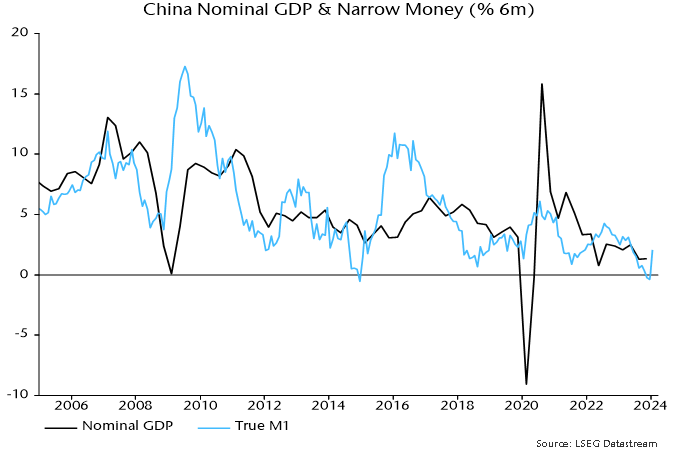
<p>Six-month growth in Chinese real narrow money M1 has been broadly stable since mid-2012 at slightly below the long-run average &ndash; see first chart. Weakness in 2011 and the first half of 2012 correctly foreshadowed a significant economic slowdown. Current growth is consistent with stable but slightly below-par economic expansion &ndash; in line with the official goal.<br /><br />Chinese real broad money M2 is rising faster but, as in other countries, the narrow measure appears to be more closely correlated with future spending. The consensus focuses on M2 and credit measures, partly explaining recent overoptimism about economic prospects.</p>
<p>Six-month growth rates of Japanese real M1 and M3 have firmed over the past year but remain within recent historical ranges and are unexceptional by international standards &ndash; second chart. A significant further pick-up may be needed to support expectations of faster economic expansion implied by current stock prices.</p>
<p><span class="full-image-block ssNonEditable"><span><img src="http://newstar.squarespace.com/storage/130513-chart1.gif?__SQUARESPACE_CACHEVERSION=1368455018652" alt="" /></span></span></p>
<p><span class="full-image-block ssNonEditable"><span><img src="http://newstar.squarespace.com/storage/130513-chart2.gif?__SQUARESPACE_CACHEVERSION=1368455040160" alt="" /></span></span></p>]]></content></entry><entry><title>UK banks still cutting savings rates, widening margins</title><id>http://moneymovesmarkets.com/journal/2013/5/10/uk-banks-still-cutting-savings-rates-widening-margins.html</id><link rel="alternate" type="text/html" href="http://moneymovesmarkets.com/journal/2013/5/10/uk-banks-still-cutting-savings-rates-widening-margins.html"/><author><name>Simon Ward</name></author><published>2013-05-10T14:45:37Z</published><updated>2013-05-10T14:45:37Z</updated><content type="html" xml:lang="en-GB"><![CDATA[<p>UK quoted mortgage rates were little changed in April but rates offered on new fixed-rate bonds continued to plunge, according to Bank of England data released today. Banks, in other words, continue to widen margins.<br /><br />Two-year fixed-rate bonds now offer only 1.90%, down from 3.24% in June 2012, just before the introduction of the funding for lending scheme. The decline of 1.34 percentage points (pp) compares with reductions of 1.00 and 0.87 pp in rates on two-year fixed-rate mortgages at 90% and 75% loan-to-value (LTV) respectively &ndash; see first chart.<br /><br />Margins have also widened on floating-rate products. The average standard variable rate has actually <span style="text-decoration: underline;">risen</span> by 0.12 pp since June 2012, even though banks are paying 0.57 pp less on instant-access deposits offering a bonus.<br /><br />Wider bank margins are desirable to strengthen balance sheets and support future lending but the punishment being meted out to savers &ndash; with official approval &ndash; is brutal.<br /><br />The second chart shows that a yawning gap has opened up between the dividend yield on the FTSE all-share index and the rate on two-year fixed-rate bonds. Retail buying of equity funds, unsurprisingly, has picked up, though currently remains modest: IMA figures show a net inflow of &pound;3.8 billion in the six months to March, up from &pound;800 million in the prior half-year.</p>
<p><span class="full-image-block ssNonEditable"><span><img src="http://newstar.squarespace.com/storage/130510-chart1.gif?__SQUARESPACE_CACHEVERSION=1368199007387" alt="" /></span></span></p>
<p><span class="full-image-block ssNonEditable"><span><img src="http://newstar.squarespace.com/storage/130510-chart2.gif?__SQUARESPACE_CACHEVERSION=1368199038037" alt="" /></span></span></p>]]></content></entry><entry><title>A "monetarist" case for UK optimism</title><id>http://moneymovesmarkets.com/journal/2013/5/9/a-monetarist-case-for-uk-optimism.html</id><link rel="alternate" type="text/html" href="http://moneymovesmarkets.com/journal/2013/5/9/a-monetarist-case-for-uk-optimism.html"/><author><name>Simon Ward</name></author><published>2013-05-09T09:23:26Z</published><updated>2013-05-09T09:23:26Z</updated><content type="html" xml:lang="en-GB"><![CDATA[<p>Rather than &ldquo;flatlining&rdquo;, the British economy has been regaining momentum since late 2011. This trend is obscured in official GDP statistics by various special factors &ndash; North Sea production weakness, an extra bank holiday and the Olympics. Adjusting for their effects, the quarterly change in output has risen from -0.1% in the fourth quarter of 2011 to 0.0%, 0.1%, 0.2%, 0.2% and 0.3% in the first quarter of 2013 &ndash; a clear upward trend.<br /><br />Recent numbers, moreover, probably understate economic improvement because official first estimates of growth tend to be revised up during recovery periods. Quarterly GDP changes since the start of 2009 have already been revised by an average of +0.15%. So the current estimate of a 0.3% increase in underlying output in the first quarter of 2013 may reflect &ldquo;true&rdquo; expansion of about 0.5%.<br /><br />The recent growth revival is no surprise to economists of a &ldquo;monetarist&rdquo; persuasion. The Friedmanite rule is that the real or inflation-adjusted money supply leads demand and activity by about six months. Economic weakness in 2011 was foreshadowed by a contraction from mid-2010 in real broad money, as measured by non-financial M4, comprising physical cash and sterling deposits held by households and non-financial firms. The six-month change in real money, however, turned positive in late 2011 and rose further in early 2012, signalling a stronger economy from the second half.<br /><br />Why has real money growth revived? Part of the story is a slowdown in inflation after a 2011 spike driven by a combination of higher VAT, strong global commodity prices and the lagged impact of exchange rate weakness.<br /><br />Nominal money trends, however, have also improved, despite continued weakness in bank lending. This may partly reflect the Bank of England&rsquo;s QE programme but, interestingly, the recovery began before gilt purchases were restarted in October 2011. QE may have had a much smaller impact than the Bank claims: its operations may have substituted for gilt purchases by banks, which were under strong pressure to raise their liquidity ratios &ndash; such buying has similar monetary effects. QE has boosted banks&rsquo; reserves, allowing them to meet liquidity targets without expanding their gilt holdings.<br /><br />A less-discussed reason for faster money growth is the effort by banks to restructure their liabilities to reduce reliance on non-deposit and overseas funding. The repayment of such funding can lead to an expansion of domestic deposits included in the money supply. An example would be an overseas investor using funds returned by a UK bank to buy a UK corporate bond at issue &ndash; a fall in banks&rsquo; overseas liabilities would then be matched by a rise in corporate deposits. The ongoing shift in bank funding sources may partly explain why money growth has remained solid despite the suspension of QE in November 2012.<br /><br />Real non-financial M4 rose at an annualised rate of 2.1% in the six months to March. The composition of growth is encouraging, with strength focused on cash and instant-access deposits &ndash; these components, which constitute narrow money M1, are more likely to be related to future spending. Real non-financial M1 increased by 5.4% annualised in the latest six months.<br /><br />Sectorally, corporate money holdings are expanding faster than those of households. Corporate liquidity has a closer relationship with the economic cycle &ndash; similar increases historically have presaged stronger investment and hiring, with a resulting rise in wage incomes lifting consumer spending.<br /><br />Some commentators claim that companies are holding more money because of a lack of profitable investment opportunities and as a precaution against cash flow problems, given the difficulty of accessing bank credit. It is certainly plausible that the desired ratio of bank deposits to borrowing has risen as a result of the recession and more restrictive credit conditions. The actual ratio, however, has climbed by more than two-fifths in the four years since the economy bottomed, reaching a new high in data extending back to 1998 &ndash; this is unlikely to be fully explained by rising precautionary liquidity demand.<br /><br />There is, moreover, no sign of any breakdown in the relationship between corporate money growth and the economy. The &ldquo;soft patch&rdquo; in 2011 was preceded by a contraction of real corporate liquidity. Recent economic improvement has occurred on schedule following a liquidity revival in 2012.&nbsp; Six-month growth in real corporate M4 holdings was 5.7% annualised in March and reached 7.9% in January &ndash; the highest since 2007.<br /><br />Monetarist optimism on economic prospects contrasts with &ldquo;creditist&rdquo; pessimism, based on the idea that a pick-up in bank lending is a precondition of stronger growth. This notion, however, is at odds with historical evidence that, while money leads the economic cycle, credit is a coincident or lagging indicator. In the US, the Conference Board includes bank business loans and consumer credit in its lagging economic index. <br /><br />This lagging relationship suggests that bank lending will revive as growth continues to strengthen during 2013. There are already hopeful signs, such as a rise in unused sterling credit facilities in the six months to March &ndash; the first such increase since 2007. A credit pick-up, in turn, would provide additional support for monetary expansion.<br /><br />The monetary foundations for a sustainable economic recovery are in place. The Bank of England should avoid further policy experimentation and focus on achieving its inflation target while allowing banks to operate in a stable regulatory environment.</p>]]></content></entry><entry><title>Global monetary trends still suggesting solid expansion</title><id>http://moneymovesmarkets.com/journal/2013/5/7/global-monetary-trends-still-suggesting-solid-expansion.html</id><link rel="alternate" type="text/html" href="http://moneymovesmarkets.com/journal/2013/5/7/global-monetary-trends-still-suggesting-solid-expansion.html"/><author><name>Simon Ward</name></author><published>2013-05-07T14:01:55Z</published><updated>2013-05-07T14:01:55Z</updated><content type="html" xml:lang="en-GB"><![CDATA[<p>The global economy has strengthened in early 2013 &ndash; the six-month change in G7 plus emerging E7 industrial output rose from -0.2% in September 2012 to an estimated 2.4% in March (not annualised). This pick-up was predicted by faster global real narrow money expansion between spring and autumn 2012 &ndash; monetary trends lead activity by about six months, according to the &ldquo;monetarist&rdquo; rule.<br /><br />The forecast here has been that global growth would moderate but remain respectable from spring 2013, reflecting a minor slowdown in real money expansion in late 2012 / early 2013. The six-month change in G7 plus E7 real money, however, edged higher again in March and is solid by historical standards &ndash; see first chart. The global economy, therefore, is unlikely to slow much over the summer. Incoming news, indeed, may beat current conservative expectations.<br /><br />Global real money expansion is lower than last autumn only because of a slowdown in the US &ndash; trends elsewhere have improved. As previously discussed, the US narrow money numbers may have been affected by the removal of unlimited insurance on demand deposits at the end of 2012, prompting a shift into interest-bearing deposits or repos. Lower US real money growth, in other words, may not signal a material deterioration in economic prospects.<br /><br />The suggestion that US economic expansion will remain respectable is supported by the latest Fed survey of senior bank loan officers. The net percentage of banks tightening standards on business loans usually surges ahead of significant economic weakness but fell further in April, to the bottom of the historical range &ndash; second chart. (Note that the net percentage is plotted inverted. The Fed survey was suspended between 1984 and 1990, explaining the data break.)<br /><br /></p>
<p><span class="full-image-block ssNonEditable"><span><img src="http://newstar.squarespace.com/storage/130507-chart1.jpg?__SQUARESPACE_CACHEVERSION=1367936573938" alt="" /></span></span></p>
<p><span class="full-image-block ssNonEditable"><span><img src="http://newstar.squarespace.com/storage/130507-chart2.jpg?__SQUARESPACE_CACHEVERSION=1367936604779" alt="" /></span></span></p>]]></content></entry><entry><title>Stronger UK economy lifting credit prospects</title><id>http://moneymovesmarkets.com/journal/2013/5/3/stronger-uk-economy-lifting-credit-prospects.html</id><link rel="alternate" type="text/html" href="http://moneymovesmarkets.com/journal/2013/5/3/stronger-uk-economy-lifting-credit-prospects.html"/><author><name>Simon Ward</name></author><published>2013-05-03T14:13:34Z</published><updated>2013-05-03T14:13:34Z</updated><content type="html" xml:lang="en-GB"><![CDATA[<p>Today&rsquo;s stronger services purchasing managers&rsquo; survey for April is further evidence in favour of the &ldquo;monetarist&rdquo; forecast here of solid UK economic growth in 2013, reflecting the lagged impact of faster real money supply expansion.<br /><br />Monetarist optimism contrasts with &ldquo;creditist&rdquo; pessimism, based on the idea that a pick-up in bank lending is a precondition of a stronger economy. This notion, however, is at odds with historical evidence that, while money leads the economic cycle, credit is a coincident or lagging indicator. In the US, the Conference Board includes bank business loans and consumer credit in its lagging economic index. <br /><br />This lagging relationship suggests that bank lending will revive as growth continues to strengthen during 2013. There are already hopeful signs, such as a rise in sterling unused credit facilities in the six months to March,&nbsp; the first such increase since 2007 &ndash; see chart. A credit pick-up, in turn, would provide additional support for monetary expansion.<br /><br />The authorities, of course, will claim that a recovery in bank credit reflects the success of the funding for lending scheme and will try to argue that this recovery is driving a stronger economy, rather than vice versa.</p>
<p>The monetary foundations for a sustainable economic recovery have been laid. The Bank of England should avoid further policy experimentation and focus on achieving its inflation target while allowing banks to operate in a stable regulatory environment.<br /><br /><span class="full-image-block ssNonEditable"><span><img src="http://newstar.squarespace.com/storage/130503-chart1.gif?__SQUARESPACE_CACHEVERSION=1367593062229" alt="" /></span></span></p>]]></content></entry></feed>