

US money update: mixed signals
US narrow money is growing slowly, casting doubt on expectations of economic strength. Broad money growth is faster but still within a normal range (and has been less informative about near-term economic prospects historically).
December numbers support the contention in a previous post that the Fed series for demand deposits has been distorted by the inclusion in mid-November of accounts previously classified as savings deposits. Weekly figures show a large jump over two weeks*, with a corresponding drop in “other liquid deposits”, which includes savings deposits. Demand deposits have since returned to weak expansion – see chart 1.
Chart 1
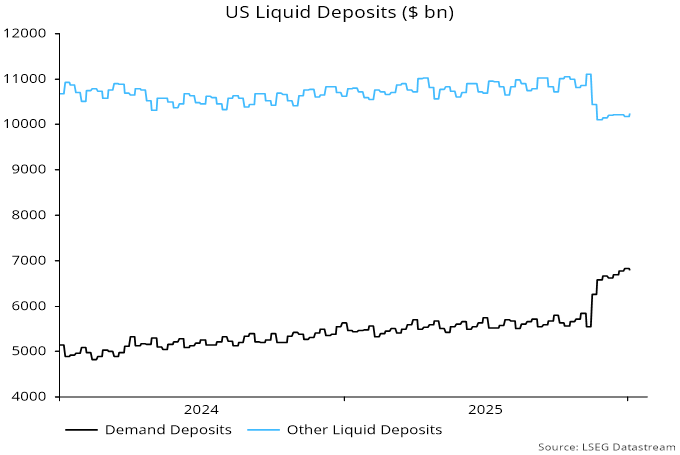
The distortion has affected the M1A narrow money measure calculated here, comprising currency in circulation and demand deposits. Similar reclassifications appear to have occurred in several months over 2020-22, following removal of reserve requirements in March 2020, which effectively equalised the treatment of demand and savings deposits. The procedure adopted then was to assume that monthly growth of demand deposits would have matched that of total liquid deposits in the absence of the distortion.
Applying the same adjustment now suggests “true” six-month growth of M1A of 3.8% annualised in December, down from 5.3% in November. This is very similar to growth rates of the official M1 and M2 measures, as well as currency in circulation (3.9%, 4.3% and 3.9% respectively) – chart 2.
Chart 2
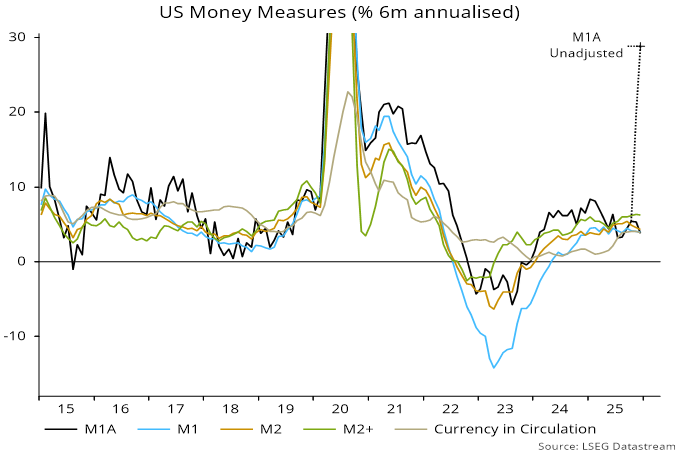
A broader “M2+” aggregate rose by 6.2% annualised over the same period, reflecting strong expansion of institutional money funds. (Official M2 includes retail but not institutional money funds.) Still, this growth rate is within an acceptable range of a suggested 5% pa “target” – the average over 2015-19, a period of moderate economic growth and inflation quiescence.
*The inclusion would have occurred on a single day but weekly numbers are averages, so the impact of a mid-week change would be spread over two weeks.
Various other indicators certainly seem to suggest a slowdown. But it’s been different so far since 2022 and it might continue to be.