

UK house prices: (much) more downside
UK house prices have fallen significantly relative to rents since 2022. The assessment here is that they would need to decline by a further 14-37% to represent “fair value” by historical standards.
The basis for the calculations is a measure of the rental yield derived from the national accounts, by dividing aggregate rents (actual and imputed) by an estimate of the value of the housing stock*.
This yield bottomed at 4.0% at end-2022 and is projected to reach 5.2% by end-2026, based on H1 rental growth and an assumption of stable prices over the reminder of the year – see chart 1.
Chart 1
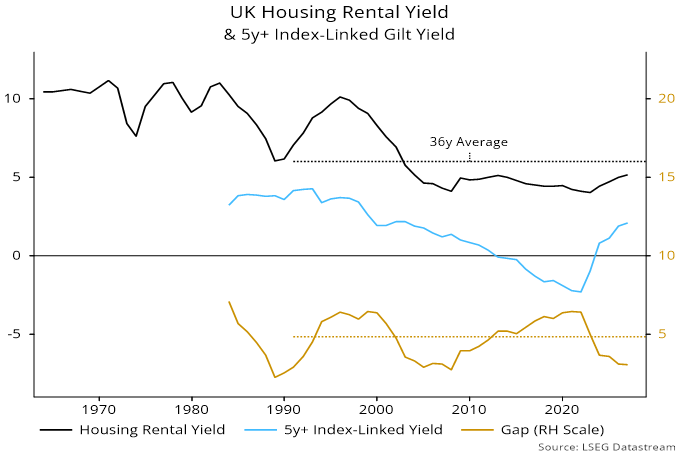
The yield, however, has averaged 6.0% over the last 36 years (representing two complete housing cycles). Based on current rents, prices would need to fall by a further 14% to achieve this level.
An assessment of fair value should also take into account yields / expected returns on competing investments. Index-linked gilts are a “risk-free” alternative, their coupons providing similar inflation protection to rents.
The premium of the rental yield over the yield on over-five-year index-linked gilts averaged 4.8 pp over the last 36 years, currently standing at 3.1% – chart 1. Closing the gap would require a 37% fall in house prices, based on current rents and assuming an unchanged real yield.
The comparison with index-linked offers a different interpretation of recent history. Rather than signalling house price overvaluation, the low level of the rental yield at end-2022 was consistent with still-negative index-linked yields – the rental yield premium was close to its long-term average.
The rise in the rental yield since then has lagged the increase in index-linked yields, resulting in the rental yield premium falling to its lowest level since 2007.
The suggestion, therefore, is that housing has become more expensive despite a rising absolute level of the rental yield, with the degree of overvaluation now comparable with the beginning of the crash phase of the last 18-year cycle.
*See footnote in previous post for more details.
Would you comment on housing versus average wages, and how that plays into this? Thanks!
An economy-wide house price to earnings ratio can be calculated by dividing the value of the housing stock by aggregate household disposable income. This ratio currently stands at an estimated 4.27 versus a 36-year average of 3.83, suggesting a required 10% fall in prices. This is similar to the 14% decline implied by a comparison of the rental yield with its 36-year average.
As argued in the post, however, an assessment of “fair value” should also take into account returns available on competing investments, such as index-linked gilts. Unless real yields fall back, house prices may need to undershoot their historical averages relative to rents and earnings.